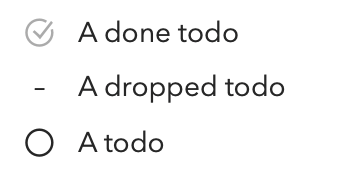
Love agenda so far, but there is one key item on which I think it can be even more awesome (next to Office 365 support for tasks/events/meetings)
Get an overview of ALL checkboxes that are unchecked! This way you can track better what still needs to be done and what has been checked off. With this feature you will not forget any action anymore
Sure. There are lots of ways to do it. It’s just a question of figuring out the best, and fitting that in with other high priority items like images and attachments.
Same here +1. I would appreciate an option/preference for the “On My Agenda”-view, so I can add all Notes with unchecked checkboxes even if they are in a project which is not checked to be “On My Agenda”.
If you do, it’d be a lot more helpful for me if I there was a way to mark a todo item as dropped, like turning the circle to an x’ed circle or some such.
This is because I have a lot of unchecked todos for a lot of reasons, including in my diary project, I have a list of things I want to do today, but I’m going to move them on to another day when I don’t get to them all. I don’t always want to delete them from the current day.
I suppose you could get complex and borrow symbols from bullet journaling, though it might get to complex!
——
Maybe not about bullet jouranlaing! Just realized they use odd symbols. Maybe just add forward arrow or x’ed.
It becomes more and more imminent to have some functionality as this. With more notes coming in, it’s getting way more hard to track all the work that has to be done (incl. if you tagged someone in a line with a ‘checkbox’ in front of it…Has me, he/she done the work already or not.
On the ‘task overview page’ it would be great if it’s summarised per project, have all the checkboxes there, and maybe drill down to ‘tagged’ members (but let’s first get the overview of unchecked checkboxes in there…that would make agenda even more awesome.
+1 for this item, even if it was just searching for the “◎” or “◉” symbols.
My use case here is that when I’m in meetings, I create checklists as the set of action items for that meeting. Being able to quickly see which action items are open allows me to quickly address them, and not forget about them (which is something that currently happens).
I know this is old, but for anyone interested, I accomplish this by changing the item’s list type from checklist to normal list item. When it’s mixed in with a list and clearly a todo, it’s an indicator that I’ve dropped it but am still keeping it for reference.